Every parent wants their child to do well in life. Good marks, a strong academic record, and a secure future often become the top priorities.
But in the middle of all this, one important question is often overlooked:
Is your child truly healthy and physically fit?
A recent report published in the Times of India has highlighted a concerning reality, only 1 in 3 school children meets basic fitness levels, and just 34% have adequate stamina.
This is not just a statistic. It is a reflection of what is quietly happening around us in our homes, schools, and everyday routines.
Understanding the Current Situation
The report is based on a large-scale study conducted across India, covering a wide range of students from different cities and schools.
To better understand the situation, here is a simplified snapshot of the key findings:
School Children Fitness Data (India)
| Parameter | Insight |
| Total children assessed | 1,40,000+ students |
| Schools covered | 333 schools |
| Cities included | 112 cities |
| Children meeting fitness standards | Only 34% |
| Key concern | Low stamina (aerobic fitness) |
| Stronger areas | Flexibility and basic strength |
| Overall observation | Endurance is the weakest factor |
Source: Read full article on Times of India
What This Means for Your Child
At first, these numbers may feel like just data. But when we relate this to everyday life, the picture becomes much clearer.
Many children today:
- Get tired more easily
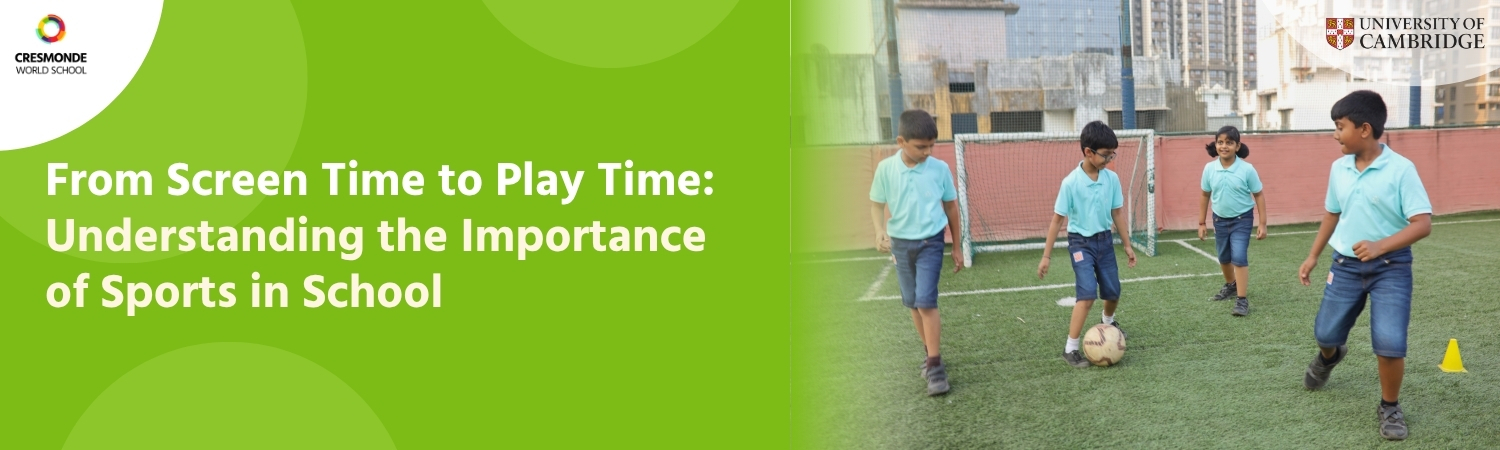
- Prefer screens over outdoor play
- Spend less time being physically active
The biggest concern highlighted in the report is low stamina.
And this is exactly where the importance of sports in school becomes clear.
Stamina is not just needed for sports—it affects a child’s daily energy, focus in class, and overall health. When children are physically active, they are naturally more alert, engaged, and confident.
How Daily Habits Are Changing
Over the years, children’s lifestyles have changed significantly.
There is more focus on:
- Academic performance
- Tuition classes
- Digital learning
At the same time, there is less time for:
- Outdoor play
- Physical movement
- Unstructured activities
The impact of the COVID-19 pandemic has made this even more noticeable. Children became used to staying indoors, and even after schools reopened, those habits did not fully change.
As a result, physical activity slowly became optional rather than essential.
Why the Importance of Sports in School Cannot Be Ignored
For a long time, sports has been treated as something secondary—something children do only if they have time.
But the reality is very different.
Sports is not separate from education. It is a part of it.
The importance of sports in school goes beyond physical fitness.
When children participate in sports regularly:
- They become more active and energetic
- Their concentration improves
- They learn discipline and teamwork
- They handle stress better
A child who is physically active is often more confident and balanced in all areas of life.
A Trustee’s Perspective: Rethinking Education
From a broader educational perspective, this situation raises an important concern.
Are we focusing too much on marks and not enough on overall development?
True education is not just about academic success. It is about preparing children for life.
“As institutions, our responsibility is not limited to academic results. We must ensure that children grow into healthy, active, and confident individuals.”
When sports and physical education are given equal importance alongside academics, children develop in a more balanced way.
They become not just better students, but stronger individuals.
Ignoring physical fitness today can lead to challenges in the future — both physically and mentally.
The Role of Parents in Shaping Habits
Parents play a very important role in shaping a child’s lifestyle.
Children often follow what they see and experience at home. When studies are given priority over everything else, they naturally begin to believe that physical activity is less important. Sometimes, without realizing it, we encourage children to skip playtime for extra study hours.
But small changes can make a big difference.
Encouraging children to spend time outdoors, supporting their interest in sports, and creating a routine that includes daily physical activity can help build healthy habits early in life.
Balancing Academics and Physical Education
It is important to understand that this is not about choosing between academics and sports.
It is about balance.
A child who is physically active is often more alert, more energetic, and better able to focus on studies.
In fact, sports and academics complement each other.
When both are given equal importance, children perform better in all areas of life.
Final Thought
Every parent wants their child to succeed. But success should not come at the cost of health.
Because in the long run, a child who is healthy, active, and confident is far better prepared for life than one who only excels academically.
Sometimes, the simplest step — letting your child play — can make the biggest difference.