At Cresmont World school our motto is to blend the essence of Finnish education system with the best globally available curriculum choices such as ICSE board syllabus and Cambridge curriculum and ensuring that learning is as happy as it is meaningful. The shape of a child’s brain is ultimately determined by the sounds the child hears in the process of developing. A great, and often overlooked, tool for developing young brains is music – introduced by age eight.
But what really happens when children begin their musical journey at this early age? Let’s explore.
1. Music Wires the Brain for Lifelong Learning
The brain of a child under the age of eight is extremely elastic. Music’s rhythmic, melodic and structural patterns are engaging more parts of the brain simultaneously, which lights up the mind’s memory centers, the hippocampus and auditory cortex, while also ramping language processing. Studies have found that early music exposure results in stronger connections in the brain, which can promote better performance in subjects like math and reading.
At Cresmonde, we’ve seen first-hand how our young learners—especially in pre-primary school and early primary school age groups—demonstrate better concentration and communication skills when exposed to music regularly.
2. Fine Motor Skills and Coordination Improve Naturally
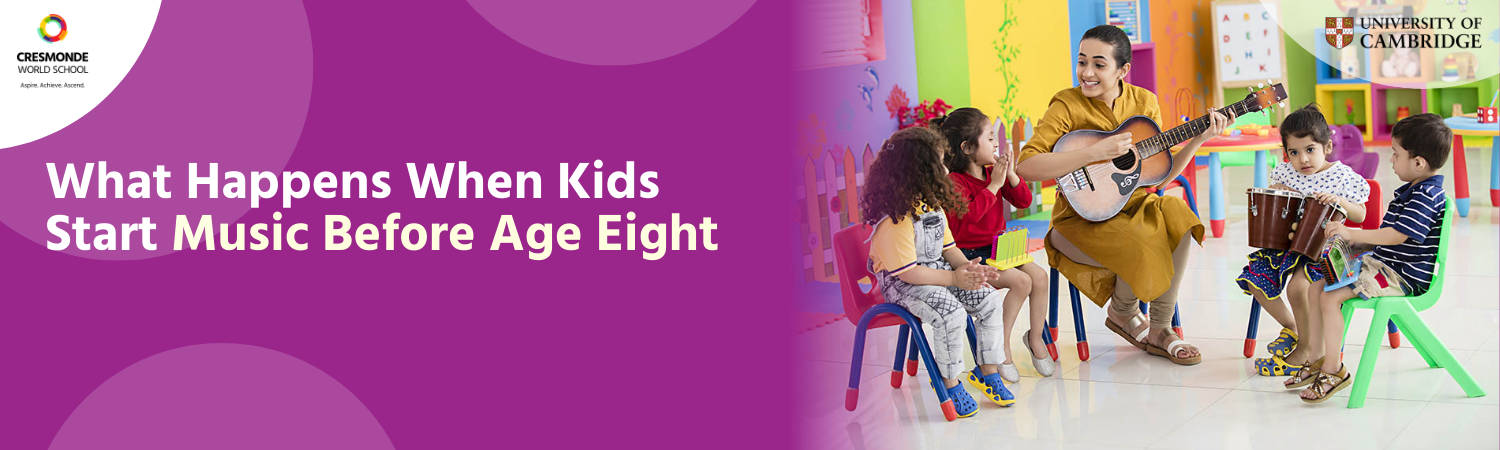
Learning to play an instrument or even participating in rhythm-based activities helps children develop fine motor skills. Whether it’s plucking a string, clapping in time, or tapping on a drum, music builds hand-eye coordination and spatial awareness—skills that also support writing and physical development.
Our music-integrated approach, inspired by the Finland education system, encourages active exploration and hands-on learning, even in the youngest classrooms.
3. Boosts Emotional Intelligence and Social Interaction
Music helps children express emotions they might not yet have the vocabulary for. It allows them to understand feelings like joy, sadness, and excitement in a safe and constructive way. Group music sessions, common in international schools in Mumbai like Cresmonde, also promote teamwork and empathy—key components of emotional intelligence.
This emotional grounding is especially vital during the nursery admission age, when children are just beginning to form their social identity.
4. Early Music Exposure Builds Confidence
The joy of mastering a song, performing in front of peers, or simply creating sounds fosters a sense of achievement. At Cresmonde, our learners are regularly involved in music activities designed not to judge performance but to celebrate effort and creativity. These early moments of success lay the foundation for long-term confidence and resilience.
And when students aspire, they naturally achieve and ascend—living out our school’s motto in full harmony.
5. Music and Academics Go Hand in Hand
Did you know that children who start music before age eight often outperform peers in problem-solving tasks and abstract reasoning? These are skills directly transferable to subjects across the ICSE board syllabus and the Cambridge curriculum.
Music activates both hemispheres of the brain. This dual activation enhances a child’s capacity to think critically and creatively—traits that we at Cresmonde strive to nurture through our integrated curriculum.
6. A Gateway to Global Thinking
Music is a universal language, and exposing children to diverse rhythms and instruments opens them up to different cultures and ways of thinking. Our inclusive curriculum, blending international best practices with local relevance, ensures that our students are not just academically ready but culturally aware global citizens.
In a city full of excellent international schools in Mumbai, what sets Cresmonde World School apart is how we embed global sensibilities into every layer of learning—including music.
Final Note: Let Them Play (Music)
Whether it’s tapping to a beat in pre-primary school, learning basic notation in primary school, or exploring cultural melodies from around the world, music offers a whole-child development path that few other disciplines can match.
At Cresmonde World School, we see music not as an extra but as essential. By introducing music early—ideally before age eight—we help children become more confident, emotionally intelligent, and academically prepared.
Because when learning feels like music, it doesn’t just stay in the mind—it stays in the heart.